Operational Excellence only becomes real when everyone owns it | Ciel Textile Website
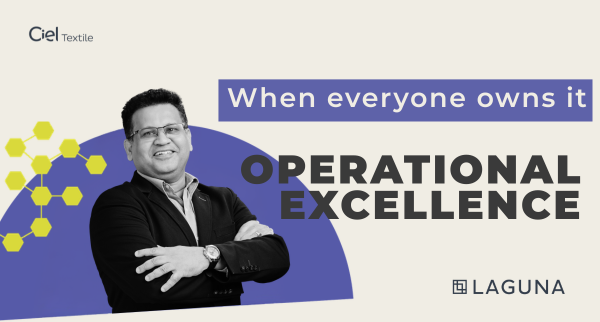
By Muthuram Barathy
Chief Operating Officer at Laguna India
In large, complex operations, operational excellence is often treated as a framework, a function, or a program to deploy.
But that is where most organizations get it wrong.
Operational excellence only becomes real when everyone owns it... from the shop floor to the leadership table.
Anything less creates gaps. And in operations, gaps show up fast: in speed, in quality, in decision-making.
This is not theoretical. In growing organizations, with multiple teams, layers, and moving parts, one weak link is enough to slow down the entire chain.
Excellence cannot exist in pockets
In scaled operations, you cannot afford isolated performance.
One team cannot operate at a high standard while another struggles and still calls it excellence.
True operational excellence is consistent, across functions, geographies, and leadership levels.
It requires the same level of clarity, discipline, and ownership everywhere.
Because when one part of the system drifts, the impact is immediate. Execution slows. Decisions hesitate. Quality becomes inconsistent.
Excellence is not about peaks; it’s about consistency at scale.
Systems don’t perform; people do
As organizations grow, leaders often focus on building better systems: more structure, more visibility, more control.
Systems are critical. They bring order, standardization, and efficiency.
But they do not deliver on their own.
People do.
They interpret systems. They adapt to them. They fix what breaks.
They drive improvements.
That is why operational excellence is never a choice between systems and people.
It is a commitment to strengthening both continuously.
If systems evolve but people don’t, execution weakens. If people grow but systems lag, efficiency breaks down.
Sustainable performance sits in the balance.
The biggest leadership challenge: alignment.
When teams grow and organizations expand, alignment becomes one of the toughest and most critical leadership challenges.
Different teams start optimizing for different priorities. Communication gaps widen. Small misalignments compound into friction.
The role of leadership is simple in theory but demanding in practice:
To bring everyone back in one clear direction; a shared vision, mission, a common understanding of priorities, a visible connection between individual work and organizational goals, and a set of values.
When people understand the larger goal and see how their work contributes to it, something powerful happens: decision and execution become faster and more confident. Teams move with more confidence. Friction reduces.
Alignment is not an abstract concept. It is a daily leadership discipline.
Rhythm creates speed; Ownership sustains it
Operational scale requires rhythm.
Clear roles. Regular reviews. Honest performance conversations. Not as control mechanisms, but as anchors for consistency.
At the same time, leaders must invest in people: through exposure, learning, and trust.
Because speed does not come up from pressure alone. It comes from ownership.
When people feel accountable, supported, and trusted to act, momentum builds naturally. And when ownership spreads, execution accelerates.
Culture and discipline make excellence stick
Process will change. Technology will evolve. Markets will shift.
What sustains operational excellence over time is simpler, and harder: culture and discipline.
Culture shapes behavior when no one is watching.
Discipline ensures standards are met every day... not just during reviews.
Together, they turn intentions into habits, and habits into performance.
Without them, operational excellence remains a slogan.
With them, it becomes the way the organization operates.
A word to future leaders
If you want to build strong operations, focus more than systems and results.
Build teams that are aligned, accountable, and continuously improving.
Create environments where people understand the goal and feel responsible for delivering it.
Because in operations, success is never individual.
It comes from people moving in the same direction, with the same level of ownership.
And when that happens, operational excellence is no longer an aspiration.
It becomes the standard.